

Charleston Sun Protection: What Your Dermatologist Wants You to Know

Living in Charleston, we spend a lot of time outside this time of year. Between beach days, boat days, golf, tennis, walking downtown, and just trying to enjoy the weather before it gets too hot, sun exposure adds up quickly here — often more than people realize.
One thing I tell patients all the time is that sun protection is not just about preventing a bad sunburn on vacation. The majority of sun damage happens gradually from everyday exposure: driving, exercising outside, sitting by a window, or running errands without sunscreen on.
And over time, that cumulative UV exposure contributes to skin cancer, premature aging, “sunspots” (lentigos), discoloration, and collagen breakdown. Here is an example below:

This is truck driver Bill McElligott, age 69. After 28 years of driving a delivery truck, the UVA rays coming through his driver-side window caused severe damage to the left side of his face — a condition called unilateral dermatoheliosis. The left side of his face appears roughly 20 years older than the right.
The good news is that effective sun protection does not have to be complicated! Here are my top three points I discuss with patients every summer:
1) Start With a Broad-Spectrum SPF 30 or Higher
If you only remember one thing, it should be this: wear sunscreen every day, not just at the beach.
I recommend choosing a broad-spectrum sunscreen with at least SPF 30. “Broad-spectrum” simply means it protects against both UVA and UVB rays.
UVB rays are what cause sunburns.
UVA rays penetrate deeper and are heavily responsible for aging, pigmentation, and long-term skin damage.
People also ask me all the time about mineral versus chemical sunscreen, and both can be great options. Mineral sunscreens use zinc oxide or titanium dioxide to physically block UV rays. I often recommend them for sensitive skin, rosacea, or melasma because they tend to be very gentle. Chemical sunscreens absorb UV rays instead. These formulas are often lighter and easier to wear daily, especially under makeup.
The best sunscreen is ultimately the one you will actually wear consistently.
Some of the SkinCeuticals sunscreens I recommend most often in our office include:
Physical Fusion UV Defense SPF 50 — excellent for sensitive skin and gives a very natural tinted finish
Daily Brightening UV Defense SPF 30 — one of my favorites for patients dealing with pigmentation or melasma
Clear Daily Soothing UV Defense SPF 50 — lightweight and great for acne-prone or redness-prone skin
One of the reasons patients like these formulas is because they feel wearable in the Charleston heat and humidity. If sunscreen feels heavy, greasy, or irritating, most people simply stop using it. I would rather patients use the sunscreen they want than none!
2) Reapplication Matters More Than Most People Think
Some of my patients are surprised when I tell them sunscreen is not a one-and-done product for the day — especially in the summer. If you are outdoors, sweating, swimming, or spending extended time in direct sun, sunscreen needs to be reapplied every few hours; more frequently if you are in the water.
There are body areas I often see overlooked:
Ears
Back of the neck
Hands
Hairline and scalp
Tops of the feet in sandals
The scalp is a huge one here in the Lowcountry, especially for men with thinning hair. I diagnose skin cancers on the scalp far more often than people would expect.
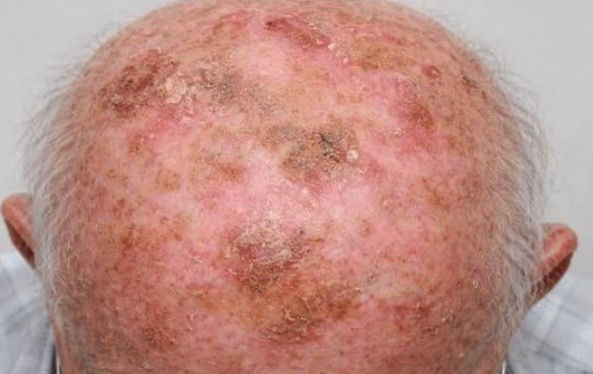
This photo shows decades of sun exposure on an unprotected scalp. Those rough, scaly, red patches are called actinic keratoses. They are precancerous lesions caused by years of accumulated UV damage.
3) Sunscreen Is Important — But It’s Not the Whole Story
I also remind patients that sunscreen works best when combined with simple sun-smart habits.
Some of the most effective things you can do:
Wear a wide-brim hat
Use UV-protective sunglasses
Seek shade when possible
Avoid prolonged direct sun exposure during peak UV hours (typically 10 AM to 4 PM)
Wear UPF-rated clothing if you are going to be outdoors for long periods
UPF clothing has honestly come a long way. Many brands now make lightweight, breathable options that are much more comfortable in hot weather than people expect.
For patients who spend a lot of time boating, fishing, golfing, or at the beach, UPF clothing can sometimes provide more reliable protection than sunscreen alone.

These twin sisters are both 61. One wore SPF regularly and the other did not — the difference is visible immediately.
What I Tell Patients Most Often
I think many people assume sun protection has to be perfect to matter, but that is not true at all. You do not need a complicated routine. Small consistent habits make the biggest difference over time. A daily SPF. A hat at the beach. Reapplying before an afternoon walk. Paying attention to the areas people forget.
That consistency adds up over the years — and your skin notices it!


Comments